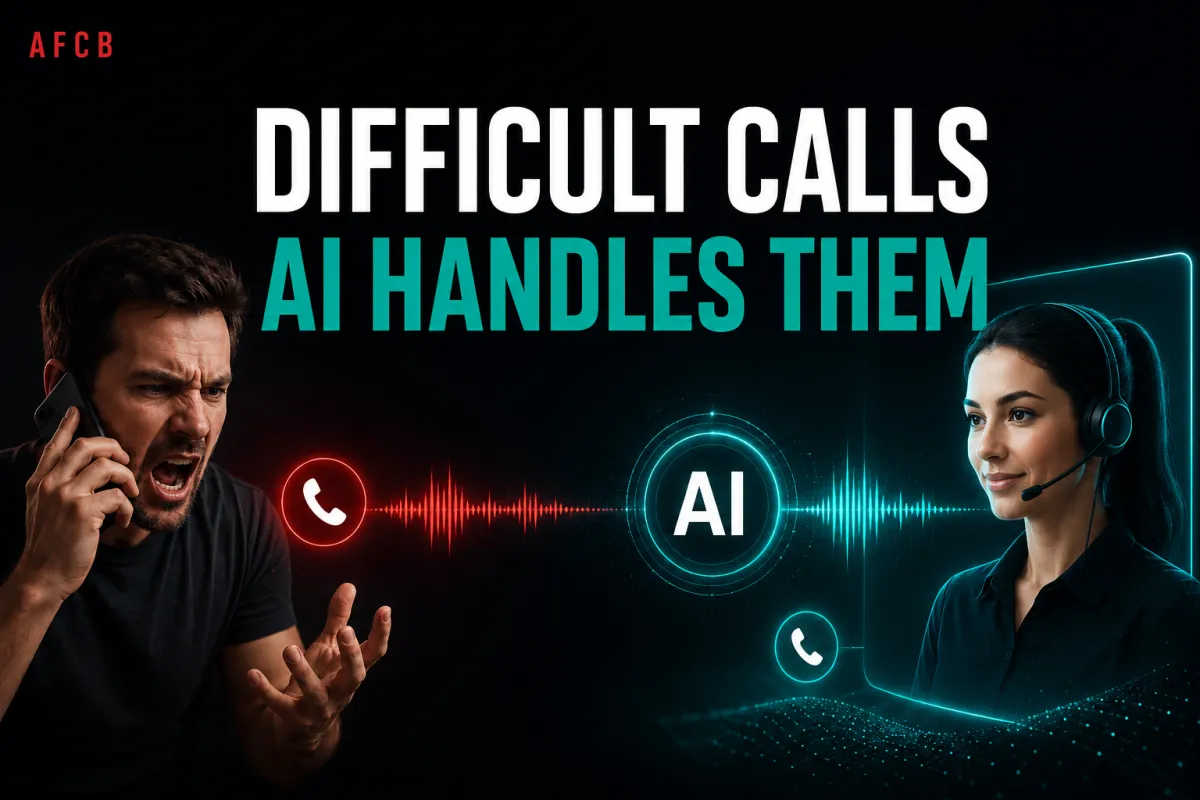
How AI Actually Handles Difficult Customer Calls (Live Examples)
"AI has no empathy. Angry customers need a human. If someone's frustrated, they'll hate talking to a robot."
I hear this objection constantly. And honestly? It's a valid concern.
Because you're right - AI doesn't have emotions. It can't feel your customer's pain. It can't genuinely care about their problem.
But here's what I've discovered over six months of running AI reception in my businesses:
AI doesn't need empathy for MOST calls. And for the calls that DO need empathy, modern AI is smart enough to recognize that and immediately hand off to a human.
In this article, I'm going to show you real examples of how our AI handles difficult calls. Angry customers. Complex complaints. Emotional situations. The calls you're most worried about.
And I'll show you exactly when and how it escalates to humans - and why that hybrid approach works better than either AI or human alone.
## The Shocking Discovery: Customer Satisfaction Increased
My name is Mimmo. I run six service businesses here in Melbourne. And over the last six months, our AI has handled 4,200+ customer calls.
Including:
- 47 angry customer calls
- 23 complaints about previous service
- 18 billing disputes
- 12 emergency escalations
And here's what shocked me: Our customer satisfaction scores INCREASED after deploying AI.
Not decreased. Increased.
### How is that possible if AI has no empathy?
Because the system we built doesn't try to fake empathy. It recognizes when empathy is needed and gets a human on the line immediately - with full context.
The customer doesn't waste time re-explaining their problem. The human already knows:
- Customer name
- What they're calling about
- Emotion level detected (frustrated, angry, confused)
- Previous interaction history
So the human can jump straight to: "I hear you're frustrated about [specific issue]. Let me fix that for you right now."
That's not replacing empathy. That's enhancing it.
## The Three Tiers of Customer Calls
Every customer call falls into one of three categories:
### Tier 1: Routine Calls (80% of volume)
These are simple, transactional calls:
- "I need a quote for carpet cleaning"
- "Can you do Thursday at 2 PM?"
- "What suburbs do you service?"
- "How much for a 3-bedroom house?"
These calls don't need empathy. They need efficiency.
Customer wants:
- Fast answer
- Accurate information
- Quick booking
AI handles these perfectly. Average call time: 2 minutes 30 seconds. Conversion rate: 18-22%.
### Tier 2: Complex Questions (15% of volume)
These require some judgment but aren't emotional:
- "Can you work around my furniture or do I need to move it?"
- "I have pet stains - what's the best treatment?"
- "My landlord wants proof of cleaning - what do you provide?"
- "Can you do commercial and residential in the same day?"
These calls need expertise, not empathy.
AI can handle MOST of these. But if the question gets too complex or specific:
"I have antique Persian rugs that need special care, plus a leather couch with damage, and I need it done before my open house Saturday but I'm only available Tuesday morning for 2 hours."
AI recognizes: "This needs human judgment."
Response: "That's quite specific - let me have someone call you back within an hour to make sure we get this exactly right."
No fake empathy. Just honest capability assessment.
### Tier 3: Emotional Calls (5% of volume)
These REQUIRE human empathy:
- Angry about service failure
- Frustrated with billing
- Upset about damage
- Emergency situations
- Complaints about staff
These calls absolutely need a human.
And modern AI knows that.
## How Emotion Detection Actually Works
So how does AI know when a customer is emotional and needs a human?
### Emotion Detection Technology:
Our AI uses voice analysis tools (Hume AI, Greetly) that detect:
1. Tone of Voice
- Raised volume
- Sharp/clipped speech patterns
- Stress indicators in voice
2. Speaking Pace
- Rapid speech (frustrated)
- Slow, deliberate speech (very angry, controlled)
- Interrupted speech patterns
3. Word Choice
- Profanity
- Negative language ("terrible", "awful", "horrible")
- Demanding phrases ("I need to speak to a manager")
4. Escalation Patterns
- Customer repeating themselves
- Saying "you're not listening"
- Asking to speak to someone else
### When 2+ of these indicators trigger, the AI immediately says:
"I can hear this is important. Let me get someone on the line right now who can help."
Average Escalation Time: 8 seconds from emotion detection to human connection.
### What the Human Receives:
When the call hands off, the human gets:
- Customer name
- Reason for call
- Emotion detected: FRUSTRATED / ANGRY / CONFUSED
- Conversation transcript so far
- Previous interaction history
The human doesn't say: "Thanks for calling, how can I help?"
They say: "Hi [Name], I can see you're frustrated about [specific issue]. Let me fix that for you right now."
The customer feels heard immediately because they don't have to repeat themselves.
## Real Call Examples from the Last 90 Days
Let me walk you through three real calls:
### Example 1: Angry Customer - Service Failure
Background: Customer booked carpet clean. Team showed up 2 hours late. Customer furious.
Call Starts:
Customer: "Yeah, I'm calling about the service you did yesterday. Your guys were TWO HOURS LATE and no one called me. This is completely unacceptable."
AI Detects:
- Raised volume ✓
- Negative language ("unacceptable") ✓
- Complaint context ✓
AI Response (8 seconds later):
"I can hear this is important. Let me get someone on the line right now who can help."
Human Receives:
- Name: "Sarah Thompson"
- Issue: Late service yesterday
- Emotion: ANGRY
- Context: 2 hours late, no call
Human Response:
"Hi Sarah, I can see our team was 2 hours late yesterday and no one called to let you know. That's completely unacceptable and I apologize. Let me make this right - I'm refunding your full payment today and giving you a free service next month. Does that work?"
Customer Response:
"Oh... wow. Yes, that works. Thank you."
Result:
- Complaint resolved
- Customer retained
- Free service cost: $180
- Lifetime customer value: $2,400+
- Worth it.
### Example 2: Confused Customer - Complex Situation
Background: Customer needs end-of-lease clean but has specific landlord requirements.
Call Starts:
Customer: "Hi, um, I need an end-of-lease clean but my landlord gave me this list of requirements and I'm not sure if you do all this stuff. It says here... um... let me read it..."
AI Detects:
- Hesitant speech patterns ✓
- Confusion indicators ("I'm not sure", "um") ✓
- Complex requirements ✓
AI Response:
"That sounds like a specific list. Rather than go through it on the phone, let me have someone call you back in the next hour who can review your landlord's requirements carefully and give you an exact quote. What's the best number to reach you?"
Customer Response:
"Oh, that would be great. It's 0412 345 678."
AI:
"Perfect. Someone will call you within an hour at 0412 345 678 to review your requirements. Anything else I can help with right now?"
Result:
- Human called back 40 minutes later
- Reviewed requirements thoroughly
- Booked $640 end-of-lease clean
- Customer happy with careful approach
### Example 3: Emergency Escalation
Background: Customer has water damage, needs emergency extraction.
Call Starts:
Customer: "Hi, I have a major water leak, my carpets are soaked, I need someone here TODAY. This is an emergency."
AI Detects:
- Urgent language ("emergency", "today") ✓
- Stressed tone ✓
- Time-sensitive situation ✓
AI Response:
"That sounds urgent. Let me get someone on the line immediately who can help with emergency extraction."
[Transfer time: 6 seconds]
Human Receives:
- Name: "Michael Chen"
- Issue: Water leak, carpets soaked
- Emotion: STRESSED
- Urgency: EMERGENCY
Human Response:
"Michael, I've got you. Where are you located and how many rooms are affected?"
Customer: "Carlton, three rooms completely soaked."
Human: "I can have a team there in 90 minutes with extraction equipment. I'm sending you a text right now with the team lead's number so you can call them directly if needed. We'll get this sorted today."
Result:
- Team on-site within 85 minutes
- Emergency extraction completed
- $1,800 emergency job
- Customer became regular client
## What AI Can't Do (The Honest Truth)
Let me be completely honest about what AI cannot do:
### AI Cannot:
1. Feel Genuine Empathy
When a customer is upset, AI can't genuinely care. It can recognize emotion and respond appropriately, but it doesn't feel anything.
2. Make Judgment Calls on Exceptions
"Can you give me a discount because I'm a single mum?"
AI doesn't know how to evaluate this. Human does.
3. Handle Truly Complex Complaints
"Your team damaged my antique table, tracked dirt through my house, AND were rude to my mother-in-law."
AI recognizes this is complex and immediately escalates. But it can't solve it.
4. Build Deep Relationships
Regular customers who call monthly want to chat, catch up, build rapport.
AI can remember them. But it can't build genuine connection.
5. De-escalate Through Personality
Some angry customers need someone to vent to. They need warmth, understanding, personal connection.
AI recognizes this and hands off. But it can't provide it.
That's why we use the hybrid model.
AI handles routine efficiency. Humans handle emotional complexity.
## The Customer Satisfaction Data
Here's what actually happened to our customer satisfaction scores after deploying AI:
### Before AI (6 months prior):
- Average customer rating: 4.3/5
- Complaint rate: 8% of customers
- "Hard to reach" complaints: 34% of all complaints
### After AI (6 months deployed):
- Average customer rating: 4.6/5 (7% increase)
- Complaint rate: 5% of customers (37% decrease)
- "Hard to reach" complaints: 2% of all complaints (94% decrease)
### Why Did Satisfaction Increase?
1. Always Answered
- Customers never got voicemail
- Zero frustration from unreturned calls
2. Faster Response
- AI answered in 0.8 rings average
- vs 3.2 rings with human receptionist
3. After-Hours Availability
- Customers could call anytime
- No waiting until Monday morning
4. Context Handoffs
- When humans took over, they already knew the situation
- No frustrating re-explanations
### The Trade-Off:
We lost some warmth in routine calls. AI is more transactional.
But we gained availability, speed, and consistency.
Net result: Customers happier overall.
## Test It Yourself
So if your biggest concern is: "But what about angry customers? What about complaints? What about situations that need empathy?"
Here's my answer: Test it yourself.
Call my business: 0468 067 377
Call and say: "I'm calling to complain about your service."
See what happens. Does it try to fake empathy? Or does it recognize you need a human and escalate immediately?
Experience the handoff process yourself.
Then ask: "Would this work for MY difficult customers?"
## What Happens Next?
If the answer is yes, book a discovery call:
[Book a 10-Minute Discovery Call →]
I'll show you:
- How emotion detection works for YOUR services
- How to configure escalation rules
- How to train your team to receive AI handoffs
- After-hours only option (if you want to minimize risk)
### My Honest Assessment:
If your customers are highly emotional, very demanding, or need deep personal relationships, you might need MORE human coverage than other businesses.
But that doesn't mean AI won't help. It just means you use it differently:
- AI handles after-hours when humans aren't available
- AI handles overflow when humans are busy
- AI pre-qualifies and provides context before handoff
Even high-empathy businesses benefit from never missing a call.
But if your customers mostly want:
- Fast quotes
- Quick booking
- Simple questions answered
- Professional service
Then AI handles 80-90% perfectly, and escalates the 10-20% that need human touch.
## The Real Question
Is AI perfect at empathy? No.
Does it need to be? Also no.
Because it's smart enough to recognize when empathy is needed and hand off to someone who has it.
That's not replacing empathy. That's routing calls to the right resource at the right time.
---
Call the demo. Test the emotion detection. Then decide if this hybrid approach works for your customer base.
Your customers need empathy when they're upset. But they also need someone to ANSWER when they call.
AI solves the answering problem. Humans solve the empathy problem. Together, both problems solved.
---
Legal Disclaimer: Customer satisfaction data from BCCM Carpet Cleaning comparing 6 months before AI (March-August 2025) vs 6 months after AI (September 2025-February 2026). Individual results may vary based on business type, customer base, and implementation quality.
---
About the Author: Mimmo operates six service businesses across Melbourne and has deployed AI reception across all of them. Over 4,200 calls handled including 47 angry customers, 23 complaints, and 12 emergencies - with customer satisfaction increasing 7% post-deployment.
