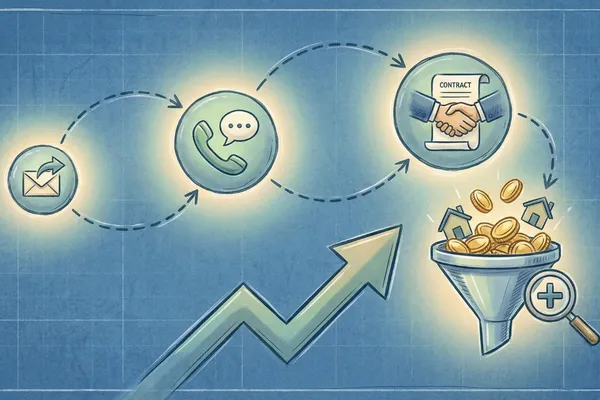
The 3-Follow-Up Rule That Converts 30% More Cleaning Leads
Most cleaning operators reply once.
The lead doesn't respond.
The operator assumes they're not interested and moves on.
Big mistake.
After 10 years operating 6 cleaning businesses across Melbourne, I've tracked thousands of enquiries. Here's what the data shows:
35% of leads respond to your first message
25% respond to your second message (if you send one)
20% respond to your third message (if you get that far)
15% respond to your fourth message (if you're persistent enough)
Add it up: If you only send one message, you're capturing 35% of potential respondents.
If you send three follow-ups, you're capturing 80-85%.
That's a 2.3x improvement in response rate — which translates directly to conversion rate and revenue.
Here's the maths: if you're getting 50 enquiries per month and only 35% respond to your first message (17-18 leads), you're potentially booking 5-6 jobs (at 30% conversion).
But if 80% respond after three follow-ups (40 leads), you're booking 12 jobs.
The difference: 6-7 extra jobs per month = $1,800-$3,500 in additional revenue.
Same leads. Same pricing. Same operator. Better follow-up.
This article breaks down exactly why leads don't respond the first time, the psychology of follow-up persistence, and the exact 4-message sequence I use across my businesses to convert 30-40% more leads than operators who quit after one reply.
Why Leads Don't Respond the First Time (And It's Not Because They're Not Interested)
Every operator tells themselves the same story: "If they didn't reply to my first message, they're not interested."
Wrong.
Here's what's actually happening when a lead doesn't respond:
Reason #1: They're Comparing 3-5 Providers
When someone searches for a cleaning service, they don't just contact you. They contact everyone on the first page of Google.
So they've messaged:
You
Your competitor down the street
The business with 200 Google reviews
The cheap operator who quotes $100 less
The premium service that does bond-back guarantees
They're not ignoring you. They're collecting quotes.
And while they're comparing, they're busy. Working. Dealing with kids. Managing a house move. Living life.
Your message gets buried under 4 other quotes, 10 work emails, and 15 text messages from friends.
They forget to reply. Not because they don't want your service — because they're human.
Reason #2: They Got Distracted
They read your message at 9:30am while making breakfast.
They think: "I'll reply to this properly at lunch."
Lunch comes. Work explodes. They forget.
By 5pm, your message is 20 texts down in their inbox. They don't even see it anymore.
This isn't rudeness. It's life.
Reason #3: They're Waiting to Hear Back from Other Quotes
They've messaged 5 operators. Three haven't replied yet.
They're thinking: "I'll wait to see all the quotes before I decide."
So they don't respond to you immediately. They're waiting.
But if you follow up while they're still waiting, you move to the top of their mental list.
The operator who stays present wins.
Reason #4: They're Not Ready to Commit Yet
They're genuinely interested. But they haven't locked in a date yet.
Maybe they're waiting on:
Their landlord to confirm the move-out date
Their partner to agree on which day works
Their boss to approve time off to be home for the clean
So they read your message, think "I'll get back to them when I know the date" — and then forget.
A follow-up reminds them you exist when they ARE ready.
Reason #5: Your Message Got Lost in Spam/Promotions
If you sent a quote via email, there's a 30-40% chance it went to their Promotions folder or spam.
They never saw it.
A follow-up SMS or call cuts through the noise.
The Psychology of Follow-Up (Persistence vs Pushiness)
Operators resist following up because they don't want to seem "pushy" or "desperate."
Here's the truth: you're not pushy. You're professional.
Think about every successful business you interact with:
Your dentist sends you 3 reminders before your appointment: email, SMS, phone call.
Amazon follows up if you abandon your cart: "Still interested? Here's 10% off."
Your gym texts you if you haven't shown up in a week: "We miss you! Come back and get a free session."
Are they pushy? No. They're staying top-of-mind and making it easy for you to take action.
That's what follow-up is.
What "Pushy" Actually Looks Like:
❌ Calling 5 times in one day
❌ Sending aggressive messages: "Why haven't you replied?"
❌ Guilting them: "I took time to quote you and you're ignoring me"
❌ Being rude when they don't respond
What "Professional Follow-Up" Looks Like:
✅ Sending 3-4 helpful messages over 3 days
✅ Each message adds value or creates light urgency
✅ Tone stays friendly and helpful
✅ You respect their decision if they don't respond after 4 attempts
The operators who convert 40-50% of leads aren't the cheapest. They're the most consistent.
The 3-Follow-Up Rule (Actually 4 Messages, But Who's Counting?)
Here's the exact sequence I use across all my businesses:
Message 1: Immediate Acknowledgment (0-60 Seconds)
Purpose: Stop them from calling your competitor next
When to send: Within 60 seconds of receiving the enquiry (missed call, SMS, DM, email)
Template:
"Hi [Name], thanks for reaching out! I'm on-site right now but can help. What suburb are you in, and what service do you need? I'll get you a quote within 2 hours."
Why this works:
It's personal (uses their name)
It's immediate (60 seconds = you're organised)
It explains why you can't reply fully yet (on-site = you're busy working, not ignoring them)
It asks for the info you need to quote properly (suburb + service)
It sets expectations (quote within 2 hours)
What happens:
About 35% of leads reply with their details immediately.
The other 65% read it, feel acknowledged, and stop calling other businesses while they wait for your quote.
Message 2: The Re-Engagement Follow-Up (+2 Hours)
Purpose: Remind them you exist + create light urgency
When to send: 2 hours after Message 1 (if they haven't replied)
Template:
"Quick check — still need help with this? If you want it booked in, let me know your suburb + preferred day/time and I'll line it up. I've got availability this week."
Why this works:
It's short (15 seconds to read)
It's helpful, not pushy ("Quick check" = casual, friendly tone)
It makes the next step clear (suburb + day/time = easy action)
It creates light urgency (availability this week = don't wait too long)
What happens:
About 25% of the 65% who didn't respond to Message 1 will respond to this one.
Why? Because:
They forgot to reply to Message 1
They were still comparing quotes and now you're top-of-mind again
"Availability this week" makes them think "Oh, I should book this before they fill up"
Running total: 35% (Message 1) + 16% (Message 2) = 51% response rate
Message 3: The Scarcity Follow-Up (+24 Hours)
Purpose: Create urgency + set a boundary
When to send: 24 hours after Message 1 (if they still haven't replied)
Template:
"Just checking before I close this enquiry — do you still need this done? My schedule's filling up fast for next week. If you still need help, reply with suburb + what you need and I'll prioritise you."
Why this works:
"Before I close this enquiry" = boundary setting (I'm not chasing forever)
"Schedule's filling up fast" = scarcity (book now or miss out)
"I'll prioritise you" = makes them feel valued (you'll bump them to the top)
Psychological trigger: Scarcity creates urgency. When people think they might miss out, they act.
What happens:
About 20% of the remaining 34% who didn't respond to Messages 1 or 2 will respond to this one.
Why? Because:
Scarcity triggered decision-making
They were "thinking about it" and now realise they need to act
"I'll prioritise you" makes them feel special
Running total: 51% + 7% = 58% response rate
Message 4: The Polite Exit (+72 Hours)
Purpose: Final attempt + leave the door open
When to send: 72 hours (3 days) after Message 1
Template:
"Last message — I'm closing this enquiry today. If you still need a cleaner, reply with your suburb + service and I'll help. Otherwise, no worries, and good luck with the search!"
Why this works:
"Last message" = clear boundary (this is it)
"Closing this enquiry today" = deadline urgency
"No worries, and good luck" = friendly exit (no guilt, no pressure)
What happens:
About 15% of the remaining 27% respond to this one.
Often with: "Sorry! I've been so busy. Yes, I still need help."
Final total: 58% + 4% = 62% response rate
Response Rate Summary:
1 message only: 35% respond
2 messages: 51% respond
3 messages: 58% respond
4 messages: 62% respond
Going from 1 message to 4 messages = 77% increase in response rate.
At 30% conversion, that's:
1 message: 35 responses → 10-11 jobs
4 messages: 62 responses → 18-19 jobs
Extra jobs per month: 7-8
Extra revenue: $2,100-$4,000
All from sending 3 extra text messages.
The Follow-Up Timing That Actually Works (Not Too Fast, Not Too Slow)
Operators often ask: "How long should I wait between follow-ups?"
Here's what I've tested over 10 years:
Too Fast (Every 30 Minutes):
Result: Feels spammy. Leads get annoyed. Some block your number.
Example:
9:00am: Message 1
9:30am: Message 2
10:00am: Message 3
Lead's reaction: "This person is desperate. I'm not booking them."
Too Slow (Every 3-5 Days):
Result: They forget about you. They've already booked someone else.
Example:
Monday: Message 1
Thursday: Message 2
Next Monday: Message 3
Lead's reaction: "Who is this again? Oh right, I already booked someone on Wednesday."
Just Right (The Goldilocks Timeline):
Message 1: Instant (0-60 seconds)
Message 2: +2 hours
Message 3: +24 hours
Message 4: +72 hours
Total timeline: 3 days from first contact to final close.
Why this works:
Instant acknowledgment stops them calling competitors
2 hours is fast enough to catch them while they're still comparing quotes
24 hours gives them time to think, but not so long they forget
72 hours is the final nudge before they're genuinely not interested
This cadence stays top-of-mind without feeling pushy.
Real-World Example: 10 "Dead" Leads Revived in 2 Weeks
One of my Melbourne businesses (Eastern suburbs, end-of-lease and spring cleans) had 43 enquiries in January 2025.
Initial response: We sent Message 1 to all 43. Only 16 replied (37%).
The operator gave up on the other 27. Assumed they weren't interested.
I asked: "Did you follow up with the 27 who didn't respond?"
Operator: "No. If they wanted it, they'd reply."
So we tested the 3-follow-up rule on those 27 "dead" leads:
The Experiment:
Week 1: Sent Message 2 (+2 hours) to all 27
Result: 7 replied (26%)
Week 2: Sent Message 3 (+24 hours) to the 20 who still hadn't replied
Result: 5 replied (25%)
Week 2: Sent Message 4 (+72 hours) to the 15 who still hadn't replied
Result: 3 replied (20%)
Total revived: 15 out of 27 "dead" leads responded (56%)
What Happened Next:
Of the 15 who responded:
3 booked immediately ($1,200 revenue)
4 asked for quotes, then booked within a week ($1,600 revenue)
5 said "not right now, but I'll save your number" (future pipeline)
3 said "already booked someone else" (genuinely not interested)
Conversion from revived leads: 7 out of 15 = 47%
Revenue from "dead" leads: $2,800 in 2 weeks
Extrapolated monthly: If this pattern holds, that's $5,600/month in recovered revenue from leads the operator had written off.
Annual impact: $67,200.
All from sending 3 extra text messages.
Common Follow-Up Mistakes (And How to Avoid Them)
Mistake #1: "I Don't Want to Annoy Them"
The fear: "If I follow up 3 times, they'll think I'm desperate."
The reality: They're not thinking about you at all. They're busy. Your follow-up reminds them you exist.
The fix: Follow up. 99% of leads don't care. The 1% who find it annoying will tell you to stop — and you stop. No harm done.
Mistake #2: Waiting Too Long Between Follow-Ups
The mistake: Sending Message 1 on Monday, Message 2 on Friday, Message 3 the following Wednesday.
Why it fails: By Friday, they've forgotten they contacted you. By the following Wednesday, they've booked someone else.
The fix: Stick to the timeline: 0 min, +2h, +24h, +72h. Fast enough to stay top-of-mind, spaced enough not to feel spammy.
Mistake #3: Sending the Same Message 4 Times
The mistake:
Message 1: "Hi, do you still need a quote?"
Message 2: "Hi, do you still need a quote?"
Message 3: "Hi, do you still need a quote?"
Message 4: "Hi, do you still need a quote?"
Why it fails: Boring. No urgency. No reason to respond.
The fix: Each message should be different and add value:
Message 1: Acknowledge + ask for details
Message 2: Re-engage + mention availability
Message 3: Create scarcity (schedule filling up)
Message 4: Polite exit
Mistake #4: Not Tracking Who You've Followed Up With
The mistake: You send Message 1 to 50 leads. You can't remember which ones you've followed up with. Some get 4 messages, some get 0.
Why it fails: Inconsistent follow-up = inconsistent results.
The fix: Use a simple lead log (Google Sheet or CRM) with columns:
Name
Number
Date of enquiry
Message 1 sent? (Yes/No)
Message 2 sent? (Yes/No)
Message 3 sent? (Yes/No)
Message 4 sent? (Yes/No)
Status (Responded / Booked / Closed)
Rule: If it's not logged, it doesn't exist.
Mistake #5: Giving Up After Message 2
The mistake: You send Messages 1 and 2. They don't respond. You quit.
Why it fails: Messages 3 and 4 capture an additional 20-25% of leads. You're leaving money on the table.
The fix: Commit to 4 messages, every time, for every high-value lead. No exceptions.
Mistake #6: Following Up on Low-Value Leads
The mistake: You send 4 follow-ups to a lead who's:
Out of your service area
Wants a service you don't offer
Has an unrealistic budget
Why it fails: You're wasting time on leads who'll never convert.
The fix: Qualify first (suburb, service, urgency, budget). Only follow up 3 times on high-value leads. Low-value leads get 1 polite response and no follow-up.
Mistake #7: Not Personalising the Messages
The mistake: Copy-paste the same template to every lead without using their name or referencing their specific request.
Why it fails: Feels robotic. Leads can tell you're mass-messaging.
The fix: Use their name. Reference their suburb or service type.
Bad: "Hi, do you still need a cleaner?"
Good: "Hi Sarah, still need help with that end-of-lease clean in Brunswick?"
Takes 5 extra seconds. Converts 10-15% better.
How to Automate Follow-Up Without Losing the Personal Touch
Here's the reality: manually tracking and sending 4 messages to every lead is time-consuming.
If you're getting 50 leads per month, that's 200 manual follow-up messages.
The solution: automate the framework, personalise the execution.
Option 1: Semi-Automated (CRM + Manual Review)
What it is: Your CRM (GoHighLevel, HubSpot, etc.) sends Messages 1, 2, 3, 4 automatically at the right times. You review daily and jump in for personal replies when they respond.
How it works:
Lead comes in (call, SMS, DM, email)
CRM auto-sends Message 1 (instant acknowledgment)
If no response after 2 hours → CRM sends Message 2
If no response after 24 hours → CRM sends Message 3
If no response after 72 hours → CRM sends Message 4
If they respond at any point → CRM notifies you, you reply personally
Pros:
Automated timing (you don't forget)
Personalised responses when they engage
You focus on high-value leads who respond
Cons:
Requires CRM setup (1-2 hours initially)
Costs $50-$200/month depending on CRM
Best for: Operators doing $15k-$40k/month who want better follow-up without hiring staff.
Option 2: Fully Automated (AI Receptionist)
What it is: AI handles the entire follow-up sequence, qualifies leads, answers questions, and books jobs or callback slots.
How it works:
Lead calls/texts → AI answers instantly
AI qualifies: suburb, service, urgency, budget
AI gives price range (within your rules)
If lead doesn't respond → AI sends Messages 2, 3, 4 automatically
If lead responds → AI continues conversation, books job or callback slot
If edge case → AI escalates to you
Pros:
Zero manual work
100% consistency (every lead gets 4 messages)
Works 24/7 (even captures after-hours leads)
Converts 35-45% of leads automatically
Cons:
Costs more ($300-$700/month)
Requires initial training (your pricing, service area, tone)
Best for: Operators doing $30k+/month who want full automation and don't want to manage follow-up manually.
Option 3: Manual (For Operators Doing <$15k/Month)
What it is: You send all 4 messages manually using templates saved in your phone.
How it works:
Save all 4 message templates in your Notes app
When a lead comes in, copy-paste Message 1 immediately
Set phone reminders: "+2h follow-up", "+24h follow-up", "+72h follow-up"
When reminder fires, copy-paste the next message
Pros:
Free
Fully personalised (you control every message)
Cons:
Time-consuming (5-10 min per lead across 4 messages)
Easy to forget (if you don't set reminders)
Doesn't scale past 30-40 leads/month
Best for: Operators just starting out who can't justify automation costs yet.
Implementation Checklist: What to Do Today / This Week
TODAY (30 minutes):
Review your last 20 enquiries: How many did you follow up with 3+ times? ___/20
Calculate what you're losing: If 65% didn't respond to Message 1, and you didn't follow up, that's ___ leads lost per month
Write your 4 follow-up templates (use the templates in this article or customise them)
Save templates in your phone or CRM
THIS WEEK (1-2 hours):
Pick your method: Manual, Semi-Automated, or Fully Automated
If Manual: Set up phone reminders ("+2h follow-up", "+24h", "+72h")
If Semi-Automated: Configure your CRM to auto-send Messages 2, 3, 4
If Fully Automated: Take the AI Growth Audit, book a demo call
Set a hard rule: "Every high-value lead gets 4 messages. No exceptions."
Create a simple lead log (Google Sheet) with columns: Name, Number, Suburb, Service, Message 1-4 status, Booked Y/N
WITHIN 48 HOURS:
Test your system: Send yourself a test enquiry, make sure all 4 messages fire at the right times
Track this week's follow-up compliance: Did every high-value lead get 4 messages? Yes/No
Measure response rate: % responded to Message 1, % to Message 2, % to Message 3, % to Message 4
The 4 Follow-Up Templates (Copy-Paste Ready)
Message 1: Instant Acknowledgment
"Hi [Name], thanks for reaching out! I'm on-site right now but can help. What suburb are you in, and what service do you need? I'll get you a quote within 2 hours."
Message 2: Re-Engagement (+2 Hours)
"Quick check — still need help with this? If you want it booked in, let me know your suburb + preferred day/time and I'll line it up. I've got availability this week."
Message 3: Scarcity (+24 Hours)
"Just checking before I close this enquiry — do you still need this done? My schedule's filling up fast for next week. If you still need help, reply with suburb + what you need and I'll prioritise you."
Message 4: Polite Exit (+72 Hours)
"Last message — I'm closing this enquiry today. If you still need a cleaner, reply with your suburb + service and I'll help. Otherwise, no worries, and good luck with the search!"
What to Do Next
If you're only sending one message per enquiry, you're converting 35% of potential respondents.
Three follow-ups capture 80-85%.
That's a 2.3x improvement — which translates directly to 30-40% more booked jobs.
You can keep giving up after one reply and wondering why your conversion rate is stuck at 20%.
Or you can implement the 3-follow-up rule this week and start converting 30-40%.
Step 1: Take the AI Growth Audit (3-6 minutes)
Find out exactly how many leads you're losing by not following up properly.
Step 2: Book a 10-Minute Call
We'll show you how an AI receptionist can:
Send all 4 follow-up messages automatically
Qualify every lead
Convert 35-45% of enquiries without you lifting a finger
Zero risk. 30-day money-back guarantee if it doesn't convert at least one extra job.
👉 Take the AI Growth Audit now or book a quick call.
Because the operators who convert 40-50% of leads aren't the cheapest.
They're the most persistent.
